Alicia Rhett, late of our City, played India Wilkes in Gone with the Wind. She was one of a handful of Southerners in the movie. Hers is no put-on Southern accent. She sounds just like most Charlestonians of a certain age and background.
Later in life, Miss Rhett had the indignity of going through a competency hearing with the Probate Court in Charleston as there was some concern by relatives that she could no longer manager her affairs.
During the competency hearing, a hypothetical question was posed to Miss Rhett about how many pieces of cornbread would she need to have to give eight people at least two slices of cornbread at a dinner party.
“My dear,” she replied, “I would never serve company cornbread at dinner.”
I think she was found to have all of her faculties.
And, she was right. Company food had and has a certain meaning.
Shrimp Creole is amazing company food.
Damon Lee Fowler, a noted food author, describes Shrimp Creole as “one of the most neglected classics in the entire repertory of modern Southern cooking.”
I agree.
In a past post, I mentioned my great-aunt, Marion Heins Peagler, late of Savannah, Georgia. She gave me our family’s go-to receipt for Shrimp Creole. It comes from her great friend Blanche Grundy, also late of Savannah. We called her “Aunt Blanche,” but she was no relation.
I have made Aunt Blanche’s Shrimp Creole for company for years. It’s really great on Christmas Eve – red, green, easy, can make it way ahead. Goes well with Easy Herb Biscuits. Easy clean up, too.
There are receipts for Shrimp Creole that are kind of sweet e.g. Charleston Receipts version. There are receipts that don’t use bacon. What’s the point?
Because someone asked for it, I now share Aunt Blanche’s Shrimp Creole with y’all.
This is EXACTLY how this was told to me by Aunt Marion. She dictated. I wrote.
Don’t be intimidated by the Heinz Chilli Sauce. It works. Don’t go all crazy and use fresh tomatoes, add a ton of garlic, add lemons or Bay leaves or any foolishness like that. Cook it as it’s written. You won’t be disappointed. It’s 20th Century cooking at its best.
Aunt Blanche’s Shrimp Creole
1 yellow onion, chopped fine
1 green bell pepper, chopped fine
3 ribs celery, chopped fine
8 slices bacon, cooked crisp, reserved and crumbled
Drippings from the cooked bacon
1 32 (or so) oz. can diced tomatoes
1 14.5 (or so) oz. can tomato sauce
1 jar Heinz Chilli Sauce
2 tbsp. Worcestershire sauce
1 tsp. salt
1/2 tsp. fresh cracked pepper
8 drops Tobasco sauce
2 lbs. peeled shrimp [I use large]
2 cups rice, cooked and hot
In a frying pan, cook bacon. Reserve drippings. Saute vegetables in drippings until soft.
[Sorry kids – this is the way I got it – usually takes about 10 mins]
In a large pot or Dutch oven, add the sauteed vegetables and drippings. Add all other ingredients except shrimp, rice, and reserved bacon. Stir well. Cook until it comes together over medium heat.
[Again – not very specific – generally, about 40 mins over medium to medium high heat is good. Want some of the liquid to evaporate]
About five to ten minutes before serving, add the shrimp and cook.
Serve over hot rice with bacon crumbled on top.
I always think it needs more than the eight drops of Tobasco
This really is great Company Food.
But, whatever you do, don’t serve it with cornbread.
The Mouse that Roared is a 1955 satirical novel by Leonard Wibberly. Peter Sellers starred in the 1959 movie of the same name. The problem is that Messers Wibberly and Sellers were premature in using that name for the book and the movie.
There is a Mouse that roared. His name is Mickey. He lives in Central Florida.
When South Carolina’s Governor Henry McMaster ordered a mandatory evacuation for all coastal counties in South Carolina on the Monday before the expected weekend arrival of Hurricane Florence, my family planned to go to Charlotte, North Carolina. We made reservations at the Marriott in Southpark.
As Shea Gibson and Mike of Mike’s Weather Page at www.spaghettimodels.com kept us up to date about the European models and shifts to the northwest, it appeared that Charlotte might get more of a lashing than Charleston.
Bearing that in mind, we were discussing evacuation with our down the street neighbors the night before the great evacuation and lane reversal. One of our friends said, “I wish I were going to Disney instead of to Sea Island.”
Mary Perrin and I looked at each other semi-knowingly.
When we got home, I said, “Well, my mother always said she’d go south depending on which way the storm came.”
Mary Perrin said, “Well, may be we should go to Disney. I think Anne Marie and Catherine [Hagood – our great traveling buddies] are going to Tampa and may go to Disney, too.”
So, we lost our damn minds and between 9 p.m. on Monday and 11 a.m. on Tuesday, we had a trip fully booked to the Happiest Place on Earth.
We could not have done it without the help of our pal Felicia Middleton Skoglund. She is a certified vacation planner through Mickey Guru Travel Company, LLC. No kidding. If you ever need anyone to plan your Disney Hurrication, contact her at (843) 822-8061. Seriously. That’s Felicia’s cell phone number. Like all good Charlestonians, her name is uniquely enunciated. It’s Fuh-lish-ah not Fuh-leesh-ah. She let me put this out for all 64 of my followers to see. All 64 of you.
Felicia arranged our Magic Bands, Fast Passes, Grand Floridian hotel rooms, and all aspects of our passports to the House of Mouse.
No “Bye, Felicia,” for us.
She knows the deals.
We had not been to Disney World in six years.
I may never go back.
Our Hurrication was wonderful, but, Man oh Man, the Magic Kingdom, the Seven Seas Lagoon, the Energy Producing Community of Tomorrow, and the Hollywood Studios reaffirm that I am not cut out for Uncle Walt’s vision of paradise on this side of the veil.
Again, we had a wonderful time, but I need not go back any time soon.
Our children loved it.
Our youngest celebrated her twelfth birthday by becoming a champion roller coaster rider.
Our sixteen year old overcame all fears by becoming a champion roller coaster rider.
I held onto my deep seated phobia of said coasters that roll.
We walked over ten miles a day.
No scooters/larks/rascals for us.
We ran into friends from Charleston who had the same idea. Why not visit Disney’s amusement park and utopian community landgrab in the middle of Central Florida? Why not have overly salted foods? Why not drink your way through ersatz foreign countries on the shores of another lake? Why not?
On one return trip aboard the Monorail to our on-campus hotel one night, our birthday girl observed “Fat people at Disney are mean.” Ouch.
We saw no one consuming turkey legs in the manner of Henry Tudor.
We saw lots of body ink. Fully committed body ink.
We saw lots of people on aforementioned scooters/larks/rascals.
We saw lots of Cokes and Sprites and popcorn and pretzels being scarfed down in the 95 degree heat.
I even rode a g.d. roller coaster, the Seven Dwarves Mine Train, which, I am told, is not even a real roller coaster. For those of us who throw up at the mention of the words roller and coaster, it was a real roller coaster, especially after eating breakfast in Belle’s Castle. Felt sick the reset of the morning. Yes, we will be your guest in the closest toilets.
The amusement park aspect of Disney does not disappoint.
I scored over 170,000 on the Toy Story Mania at Hollywood Studios. Pretty proud of that one.
Soaring at Epcot does replicate hang gliding.
Space Mountain, Thunder Mountain, and Splash Mountain thrill all who ride, but not this kid here. Nope. No way. Haven’t ridden Space Mountain since I was 6 years old. Haven’t ridden the other two since I was 14. (This was my fifth trip to Disney in 46 years).
Good old It’s a Small World and its early 1970’s kitsch never change. Our youngest pointed out where she threw up on the bend in the last room with all the puppets dressed in white the last time we were there. Yup, right into her mama’s hands. Mary Perrin quickly rinsed off in penny filled chlorinated waters. Copper has an antiseptic quality, right?
Flying over a reproduction of London on the Peter Pan ride in the cold dark alleviated the pain of so much heat and so much sweat.
Living with the Land in Epcot is a gentle boat ride.
Judy Dench’s dulcet tones guide passengers through Spaceship Earth and thirty thousand years of human history.
The Haunted Mansion’s narrator with his Midatlantic/Transatlantic Vincent Price imitation channels the ghosts of Old Hollywood.
The Mad Hatter’s tea cups spin and spin and spin and spin.
The smell of the exhaust from the speedway track gocarts still burns the upper reaches of nose hair.
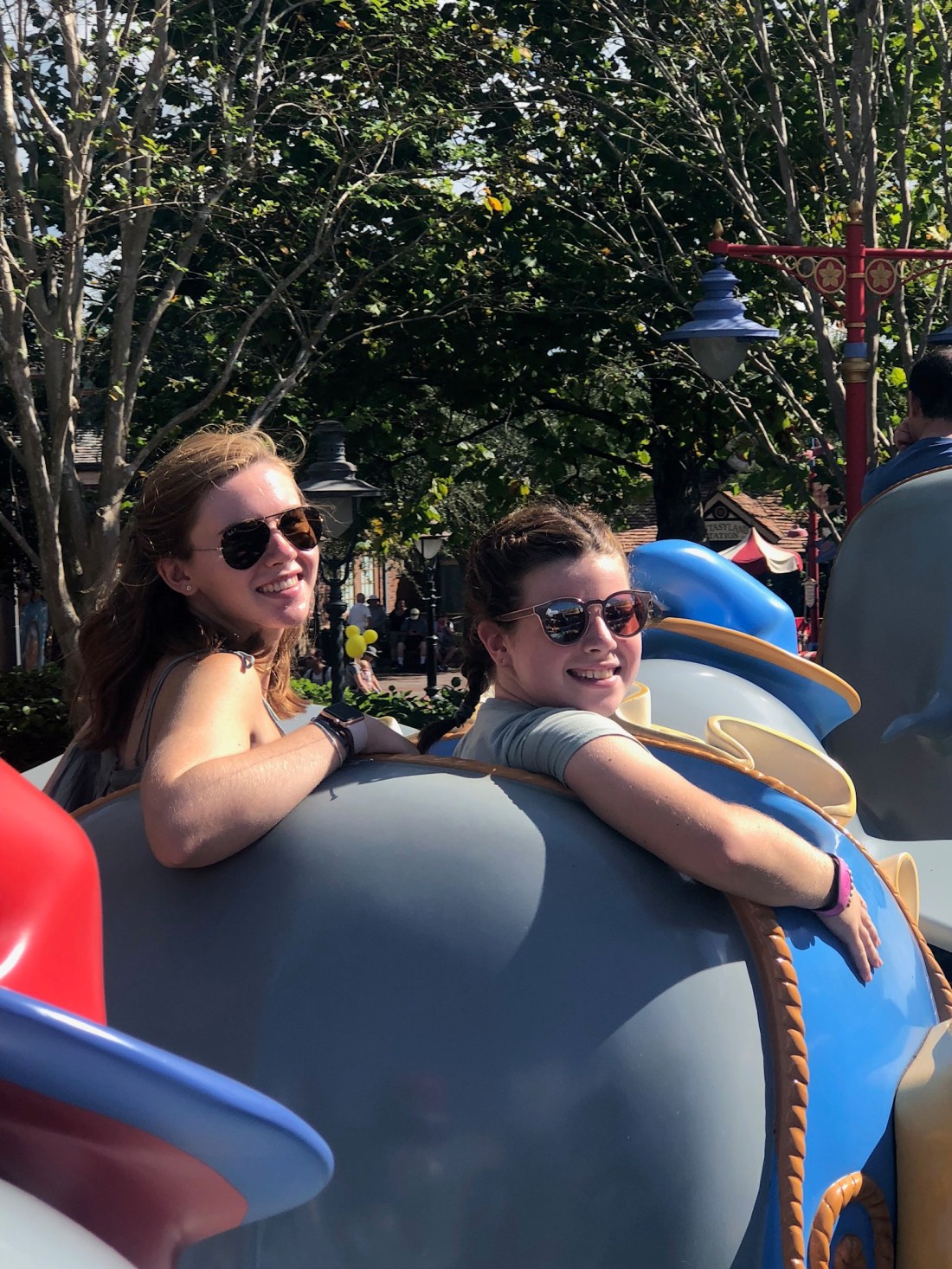
Dumbo rises above the far side of Fantasyland. He is so popular he has two rides. See? Disney can do it all. He even cloned Dumbo.
Who you calling Dumbo?
Alladin and his magic carpets fly over Adventureland.
There are still Jungle Cruises and Pirates of the Caribbean.
Animatronics, puppets, grown ups in full character suits in subtropical heat.
There are parades daily.
The fireworks over the lake boom through the night sky.
After supper one night, I sprawled out on the highly nutrified lawn at the Grand Floridian on the shores of the Seven Seas Lagoon and watched the fireworks as everyone else retired for the evening. The reflection in the lagoon made for a double view.
As I sprawled out on the grass, I thought to myself, “This is exactly where that little boy was eaten by a gator a couple of years ago.”
One night, the electric boat parade failed to impress. “Looks like the Christmas lights at the James Island County Park, Dad,” said one of my girls. Meh. Seen it.
We arrived on a Wednesday at 2 p.m.
After dropping everyone off and parking the car, I came into the gleaming heights of the lobby of the Grand Floridian, a cross between the Del in San Diego and the old Gasparilla in Boca Grande. There, my bride and girls were in deep conversation with the desk clerk about our Magic Bands, rooms being ready ahead of time, Fast Passes, and buying tickets to Mickey’s Hallowe’en Party for Friday night. More about that Comicon simulacrum later.
“Just remember,” said our ebullient clerk, “Make sure Mickey touches to Mickey with your bands.”
Mine never worked unlocking our room. Mickey touched Mickey but no luck.
After dumping off bags in the room, it was off to Hollywood Studios, a half day of which is perfect.
In trying to link up to Disney’s WiFi, one of the available networks showed on my phone as “FBI Surveillance Van #20”. I screenshot it and showed my eldest daughter. Her reply, “You know that’s just someone being funny.” “Or is it?” I replied, “I think the network listed as ‘Nancy’s Yukon’ might actually be the CIA.”
Toy Story Mania proved the best ride at Hollywood Studios. We rode it twice, and I was the high scorer each time. Boom.
The Slinky Dog roller coaster had to be shut down due to rain. Thank God I didn’t have to ride that.
We saw the Muppets silly 4-D production in the back of the studios.
Obviously Disney owns ABC as there were ads everywhere for ABC shows.
We ate supper at a reproduction of The Brown Derby. Not at Hollywood and Vine in California. There were serviceable Cobb salads for all of us. A cold martini helped.
By the time we took the bus back to the Grand Floridian it was almost 8 p.m. We were exhausted and still hot. We all took cold showers and went to bed.
The next morning we went straight to The Magic Kingdom after hopping the monorail.
“Please do not lean against the doors; [something something something in Spanish] de las puertas.” We sometimes call the monorail De Las Puertas.
We had 8:20 reservations at Be Our Guest, a kiosk service restaurant in Belle’s Castle. Again, perfectly serviceable food of breakfast sandwiches, waffles, Croque Madame, eggs and bacon. We were in the park right as the rides opened at 9:00.
Hi Ho! Our first ride was the Seven Dwarves Mine Train. Hi Ho! I’ll never ride that again. Hi Ho! Gonna hurl. Hi Ho!
We then hit the rides hard for the rest of the day, or at least until our exhaustion levels could not be overcome by sheer force of will.
We found our pals Gigi and Davis Dobbins who had also evacuated from Charleston. After we all drove the speedway, we jumped on The People Mover. It’s delightful. We also completed the Buzz Lightyear shooting gallery ride, too. Again, I kicked ass on that one. Such an achievement to be the high scorer.
The Dobbins headed for Space Mountain. We headed to another part of the Magic Kingdom.
Our great traveling buddies, the Hagoods, were going to meet us later as they, too, had keys to the kingdom. We later found that one of the Hagoods was under the weather but they were going to make it, by God, but, it’s a funny thing when our bodies say “No, no, no.” Eventually, they made it, but, ultimately had to pull the plug early.
Don’t we all? Shouldn’t we all?
When I say early, I mean around 3 p.m. This was after a full day of Thunder Mountain, Splash Mountain, and myriad magical rides, including the Happiest Cruise on Earth, because, it’s a small, small world.
Our girls were mountain people: Thunder, Splash, and Space.
No one had any lunch. Blood sugar was all over the map. We ate pretzels dipped in cheese product. We drank Co-colas. I never drink Co-colas. We felt weak. We felt hot. One of our group almost fainted.
After a full day of fun in the sun, we went back to the hotel and ran for the pool. There’s a waterslide. There’s a waterfall. There’s a full bar.
There are also aggressive young children in lifejackets climbing rocks. Hello? Parental supervision? It’s greatly lacking at the pool.
After a refreshing dip, it was time for a restorative cocktail before our Character Supper at 1900 Park Fare. It’s a buffet. It’s not good. It’s just not. Children touch everything at buffets in Disney. Literally. Small hands were everywhere. Plates were shattered. Gummy bears strewn across the tiled floors.
For a twelve year old, it’s still fun to have supper with Cinderella, Prince Charming, the Wicked Stepmother, and the Evil Stepsisters. Even the 16 year old got in on the fun, which was worth every penny, even the ones in chlorinated waters at the bottom of It’s a Small World.
The lovely bartender from New Orleans poured me two stiff bourbons prior to all of the gastronomical grostesqueness; she eased my burden.
Again, it was time for bed before we knew it.
The Fitbit on the arm of one of our girls shouted almost 20,000 steps. Even it was tired.
The next day was EPCOT. Whew.
It was super hot.
Hurricane Florence pumped moisture our way even though she was only barely coming ashore in Eastern North Carolina.
Figment is not just in your imagination. Nope. He’s right there on the ride.
Spaceship Earth in the big geodesic dome was cold and dark and Denched.
Living with the Land smells of chlorine and fish. We do love a boat ride at Disney.
We were scheduled for lunch in France at 12:15.
We made our way around the lake and stopped briefly in Mexico for another boat ride in the dark with the Three Caballeros: Donald Duck, Jose Carioca, and Panchito Pistoles. Only missing the Lady in the Tutti Fruiti Hat.
We high tailed it across Norway, China, Germany, Italy, the US of A, Japan, and Morocco. No passports required. Guess we were illegals.
We arrived at the Chefs de France pumping air conditioned goodness our way.
“This looks a little bit like Les Deux Magot,” said our eldest who spent three weeks in France this summer.
“Ah…oui…Saint-Germain des Disné” was my smarty reply in full Maurice Chevalier accent.
Our waiter was from Alsace. He could not have been nicer.
Our food was actually delicious. So were the two martinis straight up with a twist for me and the two glasses of rosé for my bride.
From there, we soared. Soaring really is a fun ride. Margaret and I soared twice. Mary Perrin and Perrin went on back to the hotel for a rest.
We got back to the hotel and the Hagoods were there ready for a night in the Magic Kingdom.
We had bought our tickets to Mickey’s Hallowe’en party. Whew boy. One and done.
There were tons and tons of folks flooding into the Magic Kingdom all dressed in costume. Why go to Comicon when you can come to Disney and ride the rides and see all manner of cosplay?
Drag queen Cruella de Vil? Check
Large lady dressed as Piglet riding her scooter? Check
Family dressed as Crayons? Check
Alice in Wonderland? Check
Two grown men as ballerinas? Check
Hippos from Fantasia also in ballerina costume? Check
Old woman Cruella de Vil in full fur coat who might stroke out at any minute? Check
Entire cast of Toy Story? Check
Tweedledee and Tweedledum? Check
Mary Poppins and Bert? Check
Peter Pan and Tinkerbell? Check
The costumes kept coming and coming and coming.
The tattoos kept coming and coming and coming.
More rides
More roller coasters
No more alcohol.
By 8:30 p.m. we had all had it. Perrin and I were the first to leave.
It was on that monorail ride back to the Grand Floridian where a large man on his scooter made such a scene that our twelve year old observed the meanness of some at Disney. She was not being cruel, but she was being observant.
This gentleman made a ruckus over getting into the monorail car. He made a ruckus getting out of the monorail car. He couldn’t get his scooter to start.
“Try turning the key,” suggested one of our fellow riders.
“Oh…..” said the man as he scootered toward The Polynesian. Do they still serve Tonga Toast?
“Hope he has a Magical Day,” I whispered to Perrin. We laughed.
The Fitbit told us we had walked over ten miles that day.
We slept like the dead.
We were out of the Grand Floridian a little after 7 a.m.
I rejoiced heading north on I4 and I95.
We stopped in DeBary, Florida, for breakfast under golden arches.
At that exit there were two huge electric transmission towers.
On every branch of latticed steel sat a large group of turkey vultures.
A grouping of vultures is called a volt after all.
Ten years ago, we were in the beginnings of the worst economic downturn since the Great Depression. I heard the late Daniel Schorr on NPR discussing the song “Brother, Can You Spare a Dime?” as I drove home one day.
I went home and wrote this 2008 version of that minor-keyed lament. I found it last week. Ten years ago. Seems like yesterday. Seems like another lifetime.
To paraphrase that one-time Charleston resident, Edgar Allan Poe, we live in a kingdom by the sea.
We have little hold on the solid ground.
We see the road beds sink on Hagood, on Lockwood. Half of the town rests fitfully on fill dirt. At high tide, we avoid certain roads.
That dwindling population of the tourist ridden Venetian Lagoon may still know that ancient catechism:
“Quid est mare? Refugium in periculis.” (As attributed to Alcuin of York)
We have no such refuge in danger. Quid est mare? She is life. She is death. She is our mother. She is our teacher. She is our best friend. She is our worst enemy. We live for and through her.
She terrorizes from May to November with the threat of hurricanes.
(Pronunciation: hurra-kins not hurra-canes)
Every hurricane season, I recite the old poem:
June, too soon
July, stand by
August, ‘most upon us
September, we’ll remember
We always remember September.
Lowcountry folk have dealt with the fickle follies of the sea for generations. We watch the gathering storms in the Cape Verde Islands. The winds blowing off the western side of Africa vex us every year as they cause us to shiver as we reserve hotel rooms in Charlotte and Greenville.
In 1893, the storm was so bad that Clara Barton herself came to help in the aftermath.
1893
Hazel
Gracie
David
Hugo
Floyd
Joaqin
Matthew
Irma
We acknowledge as Memento Mori every named storm. We live on pluff mud and sand. We know we hold nothing permanently. In the midst of life we are in death, but what a place to live.
There are fiddler crabs in the back yards some days.
Old resort towns disappeared in storms: Edingsville, St. Helenaville.
(May be don’t use “ville” in a name?)
(May be don’t build on the coast?)
We rebuild.
We renourish.
We pray that the storm jogs to the north and east.
We run to store for beer and bread
We gas up the car
We load up on dog food
We know that we who are blessed enough to live here must pay a price for the beauty.
We float on the tide.
We have no control.
~~~~~~~~~~~~~~~~~~~~~~~~~~~~~~~~~~~~
One of my favorite paintings is in the Louvre. Really. It is. No kidding. Again, such a tourist.
It’s a painting of a ship, of sorts, adrift on the sea.
The most gruesome part of the painting is at eye level in the long gallery.
A body in the water drags along shrouded in thin funereal gauze, starved ribs exposed.
A man clutches a ragged cloth to signal a ship breaking the far horizon.
Before Creation, the Spirit of God moved over the face of the waters (Genesis 1:2)
The Spirit has forsaken this vessel and all who sail upon her.
French Romanticism of an unromantic true story, a national scandal.
The painting?
The Raft of the Medusa by Theodore Gericault.
The Raft of the Medusa is the perfect metaphor for those of us who live between Campobello and Key West.
We hold to this thinning soil as those souls held to their raft flagging down distant help. We pray for deliverance from the storm.
I ran across a reminder of that painting in March seeing this study for it by Gericault himself.
Study of a Model. Theodore Gericault. For Raft of the Medusa. The Getty Museum.
I first saw The Raft of the Medusa in Paris in 1989. That same time, my friends and I were reading biographies of Jim Morrison. He was all the rage. Jim Morrison’s words were the perfect pairing for Gericault’s brushwork
“I love the friends I have gathered on this thin raft.”
As Florence pushes her evil winds and waves this way, tenously we cling to the Spirit, to each other, to this thin raft, and to this kingdom by the sea.
The Wall Street Journal ran an article recently about the slovenly sartorial stupidity of famous grown men these days. A noted actor stated that he still dressed the way he dressed when he was ten (10) years old. How embarrassing for him.
My youngest daughter loves the movie The Intern with Robert DeNiro and Anne Hathaway. In that film, DeNiro plays an older than average aged intern at Hathaway’s wildly successful e-commerce shopping company. DeNiro dresses in suit and tie every day. He carries a handkerchief. He shaves daily. He owns a bathrobe.
In one scene involving tequila shots, Hathaway bemoans the lack of men in the world. She holds up DeNiro’s well dressed character in opposition to her own T-shirted contemporaries. I get it, Ma’am. I get it.
We still dress here in the Lowcountry.
I carry a handkerchief daily.
I polish my shoes.
I wear a belt.
I tuck in my shirts.
May be it is that Southerners still wear aspiration on their backs.
May be it is the heat.
May be it is compensation for decades and decades of poverty.
May be it is country come to town.
May be it is that all my life I have worn uniforms that identify me to other members of whichever group to which I belong, or wish to belong, by virtue of what I wear.
May be it is that immediate judgment comes from first impressions despite the noble egalitarian fiction and Biblical command that we judge not lest we be judged.
There is always someone watching, someone judging.
No matter the reason, I can ill-relate to the actor who dresses as he did before puberty or to the messy internet workers in The Intern.
DeNiro’s character, I understand.
There has been an expected way to look for me my entire life. No fashion plate or clothes horse am I, but I am not going to wear a Snuggie to the grocery store. I actually saw that at the Harris Teeter on East Bay Street. A College of Charleston student wore a Snuggie. Granted, it was a chilly February morning, but come on, Dude.
I do have a definite devotion to the expected look of the time and the place e.g. that way cool Guatemalan belt with Levi’s cords and Grateful Dead T-shirt circa 1988, the tuxedo for any wedding after 6:00 p.m., the Birdwells and Rainbows on the boat or at the beach.
In a world where standards are few, we are far too casual these days, Ladies and Gentlemen. Far, far too casual.
Athleisure wear worn on the street is fifth horseman of the Apocalypse, the fourth woe unleashed on a sinful and broken world.
Is the eighth trumpet sounding?
Gratefully, I do not hear it, so, instead, I give you the following list of 46 years of conformity.
Man in Uniform, 1972-2020
Cloth diapers
Pampers
Feltman Brothers day gowns
Onesies
Diaper shirts
Family Christening gown
Leather walking shoes
Smocked bubbles
John Johns
Cotton shorts
Saltwater sandals
Fauntleroy outfits
Hard sole leather shoes with buckles
Wool short pants
Knee socks
Wool sweaters
Buster Browns
Topsiders
Blue jeans
Khakis
Blazers
Ties
Wool pants
Zips
Nikes
Garanimals
Camper shorts with zippers
Lacoste shirt
Lacoste shorts
Polo shirts
Birdwells
Sundeks
Quicksilvers
OP cord shorts
Canvas topsiders
Panama Jacks
Nylon shell shorts
Levis jeans
Levis cords
Duckheads
Reeboks
Weejuns
Bluchers
Camp mocs
Birks
Grateful Dead t-shirts
Baja hoodies
Army Navy surplus
New Balances
Converse All Stars
Addidas
Madras
Seersucker
Tevas
KSwiss
More khakis
More button downs
More blazers
First suits
Patagucci everything
Patagucci everything
No, literally, Patagonia everything
LL Bean everything
J Crew pocket t’s
Barbour coats
More Birks
Redwing cowboy boots
Irish fisherman sweaters
Norwegian sweaters
Tuxedos
Kenyan kikois
Oxfords
Rainbows
Blundstones
Guccis
Keenes
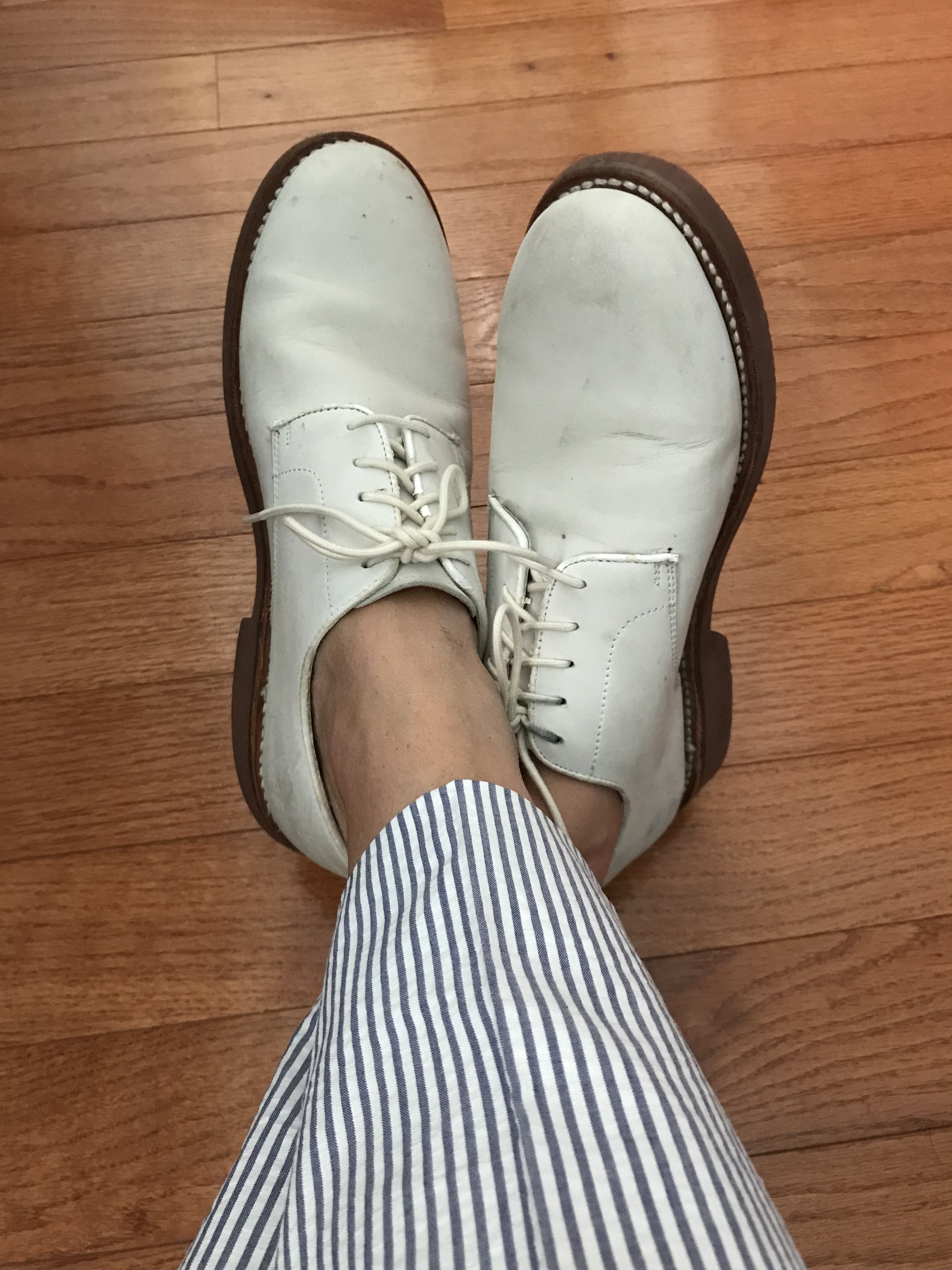
White bucks
Brooks Brothers pants
Brooks Brothers suits
Brooks Brothers Non-Iron shirts
Brooks Brothers ties
Brooks Brothers everything
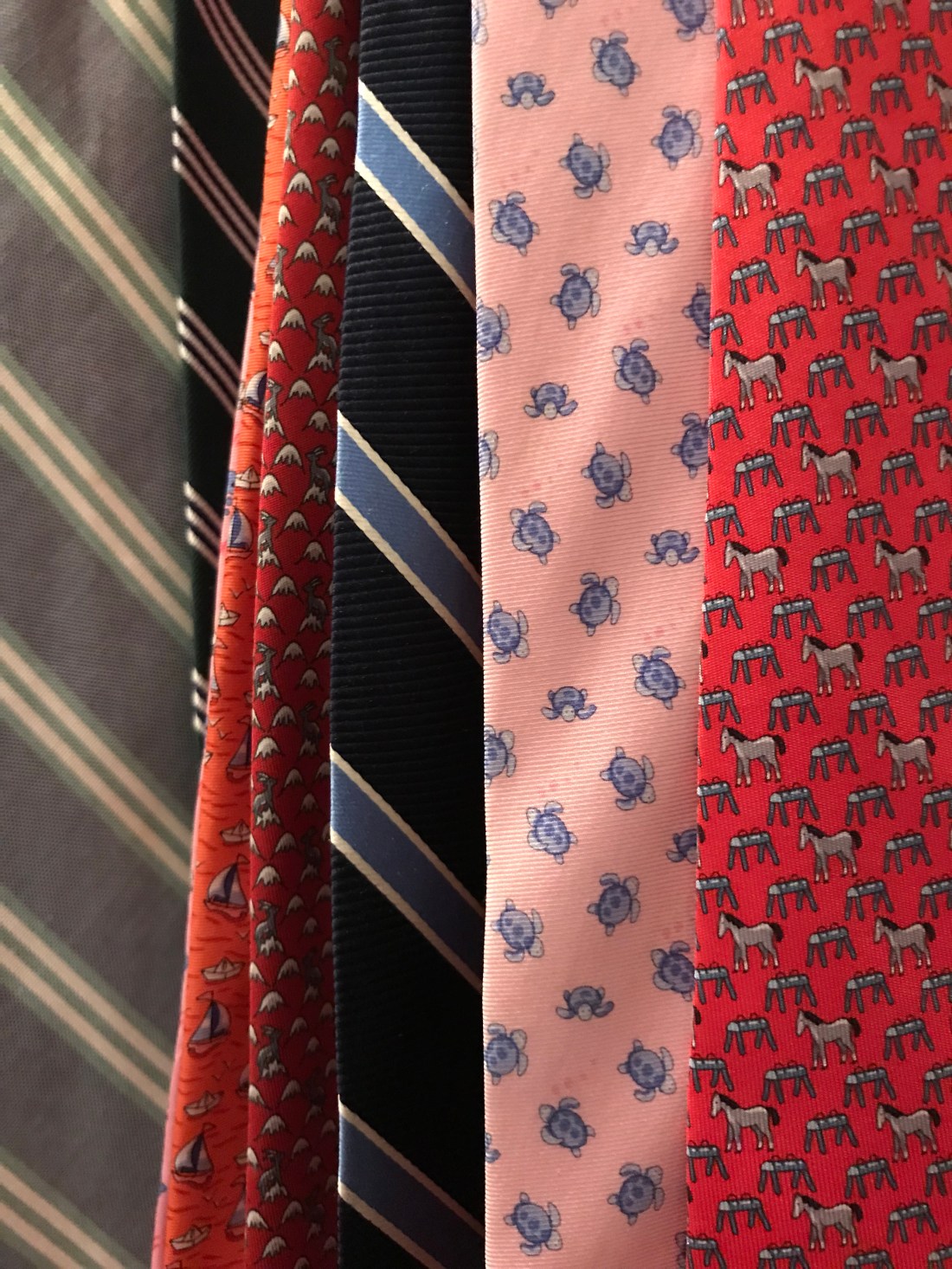
Ferragamo ties
Hermes ties
Vineyard Vines ties
Short sleeve button downs (SSBD’s)
Lacoste, again
Lululemon exercise clothes (but only to actually exercise)
Johnny O
Ledbury
Needlepointed belts
Needlepointed cummerbunds
Prince Albert slippers with socks
Prince Albert slippers without socks
White tie and tails
Alligator belts with silver buckles
Orlebar Brown
Hickey Freeman
Gitman Brothers
Ray Ban
Warby Parker
Billy Kirk
82 Church
Punch & Judy
Schein’s
Jack Krawcheck
Max’s
Warshaw’s
Berlin’s
Bob Ellis
Ludens
M. Dumas
Tabor
Always clad in uniform.
Always abiding by the code.
An acceptable manner of dress.
I.d. cards.
Tribal markings.
Inside jokes.
Beau Brummell’s Bastards.
With all my love and thanks to MP for making sure I don’t look like a complete idiot when I leave our house.
Apologies to the late Jules-Amedee Barbey d’Aurevilly’s “On Dandyism and George Brummell.”
I had been at the same school since first grade. I had gone to school with the same people since I was two years old. I had outgrown my hometown, or so I naively thought. What a brat to think that. Complete punk. But, those were my thoughts when I was in the eighth grade. I know better now. I see the magic of my home, her wonderful people, her beauty. In the mid-1980s, however, I hated her.
Over Thanksgiving, 1985, I announced to my assembled parents, grandparents, aunts, uncles, and cousins that I wanted to go to boarding school. They were all in Beaufort for the holiday. We were going to Savannah that weekend to see our family there, too.
The reply to my announcement:
“Over my dead body,” said my father.
“Oh, my, that sounds expensive,” said one aunt.
“That sounds wonderful,” said my eldest cousin who was already in college at Wake Forest.
“We’ll see, Son,” said my mother as she made ready the next day’s feast.
This was not a request.
It was demand on my part.
It was a matter of survival.
Beaufort’s size then was tiny.
Infinitesimal.
Like so many Southerners before me, I thought I was far too cool, too smart, too worldly, too put together to remain in the land where old times were not just forgotten but were ever present. The subtle racism. The not so subtle racism. The black housekeepers and nannies. The black yardmen. The segregated schools. The all white clubs. The all black clubs. The all white churches. The all black churches. The provincial attitude. The xenophobia. The busybodies who knew every one and every thing. The boredom of Sundays after church.
I had to go.
Simply had to.
Back then, Beaufort families of a certain….well….tone…sent their children to Beaufort Academy or sent them away to school. (And, by away, I mean Episcopal High School, The Asheville School, Christ School, Virginia Episcopal School, St. Mary’s, Salem, McCallie, Baylor.)
These were my people by birth and circumstance.
Back then, my father had an associate who was from Boston. She grew up on Beacon Hill on a street named for a South Carolinian. Her husband was in the Marine Corps, which was what brought them to Beaufort. When this strawberry blonde Bostonian heard that I was interested in going off to school, she told my father that I should look at schools in New England.
“They rilly are the best in the nation, George,” she said to my father. “Rilly. They are.”
Her father graduated from Phillips Academy in Andover, Massachusetts, as had one of her brothers. Her other brother graduated from Groton. What? Where? I had heard of Phillips Exeter somewhere, but Phillips Academy? Where? Andover? Where’s that?
I went to my school’s library and looked them up in reference books and guide books to schools.
According to the reference materials, our friend from Boston knew whereof she spoke.
The following summer, we took a family trip to Boston. We went out to Cape Cod and had a day on the water with our friends’ parents and grandmother, who asked, “Do ya need a fahk?” as she passed us our lobster rolls. (She sounded like a Kennedy)
My mother about fainted.
Granny passed us each a fork.
At their house near Woods Hole, the patriarch pulled me aside and said, “I think you rilly would be great at Ahndovah. It’s the oldest and best boarding school in the nation. Founded 1778. Oliver Wendell Holmes went thea. George Washington sent his nephews thea. Rilly, you’re just the type of fellah we need thea. Rilly. You are.” (He sounded like a Kennedy)
Back to South Carolina we went, but my head and heart remained in New England.
Parents of friends at Episcopal High School dropped off catalogues.
Parents of friends at McCallie dropped off catalogues.
I had no interest.
I wrote to Phillips Academy requesting their materials. I also wrote to Phillips Exeter, Groton, Lawrenceville. What hubris for a kid from the Sea Islands of South Carolina to write these schools with even the remotest inkling of matriculation at a later date.
Young and bold are sometimes the two best words in the English language.
The fall of my ninth grade year, I took the SSAT in Savannah. I filled in applications. I obtained what I hoped were glowing recommendations. I continued to do my work at Beaufort Academy. I ran for class office for the following year. I continued to hope I could go far, far, far away.
On a super cold day in January, 1987, my father and I boarded a plane in Savannah bound first for Philadelphia to go to Lawrenceville. Not a horrible place, but no fires lit in the belly upon arrival. We went back to the Philadelphia airport and flew next to Boston. We arrived in Boston on a lung piercingly cold night. We rented a car and headed north towards Andover, where we were booked at the Sheraton down on the Merrimack River. To get to the Sheraton, we had to pass Phillips Academy on Main Street.
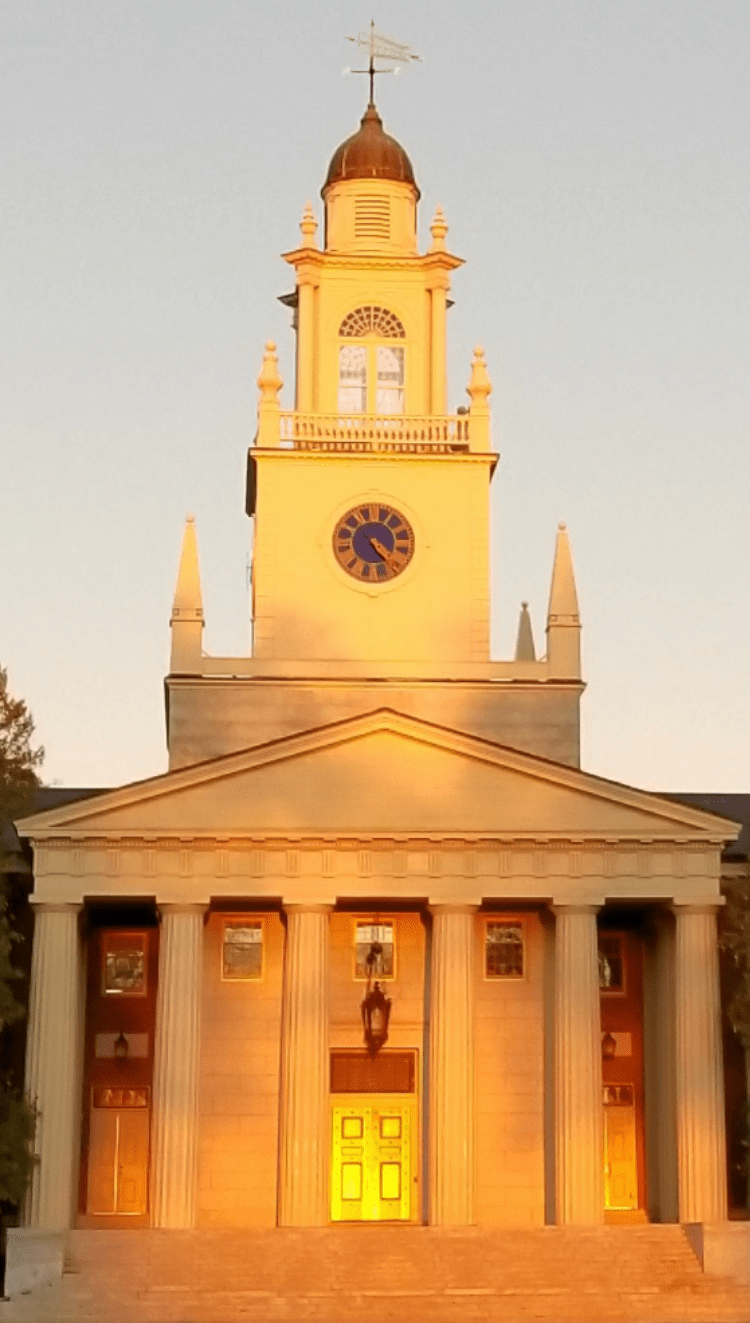
There was a bright moon that night. There was snow. There were stars. As we drove up the road, Highway 28 turned into South Main. I saw a large bell tower by the side of the road. What college is that, I wondered? Wait, that’s it. That’s Phillips Academy. That’s Andover. I recognized the Bell Tower. We passed at 35 mph. A couple of kids were walking down the street in the cold. The school’s Great Lawn shimmered mother of pearl in the moonlight and snow. The fire in my belly began to be kindled. Immediate kinship.
We arrived at the Sheraton. Even after only a glimpse through car windows, I ate the first of what I hoped would be many meals for me in the Town of Andover. We went to sleep to the sounds of the heater humming away in the wall.
The next morning we headed back to Main Street and straight to the Admissions Office. My father in a suit. Me in the male applicant’s uniform of navy blazer, tie, khakis, loafers.
At the Admissions Office, a matronly lady with white hair and a faint Southern accent greeted us, “Well, hello, I’m Grace Taylor. Welcome to Phillips Academy. Someone will be with you in a minute.”
A young man walked up and smiled. He said to Ms. Taylor, “Grace, I need that file we were talking about – Southern kid, remember?”
I knew he was talking about me. Had to be. Already admitted before my interview. Praise God.
“Here, Bobby,” said Ms. Taylor, “Right where you left it.”
“We HAVE to let this one in,” said the man named Bobby Edwards. “My mother’s from North Carolina, you know.” I was not the object of his enthusiasm. Drat.
Just then, a lady with bobbed hair and Laura Ashley dress approached and stuck out her hand. My father and I immediately stood from our Windsor chairs and shook hands.
“I’m Jeannie Dissette, Dean of Admissions. Welcome to Phillips Academy. You must be Hamlin. You must be Mr. O’Kelley. Gentlemen, your tour guide will be here in a minute. His name is Mike Megalli. Your interviewer is Bob Hulbard. First, you’ll go on a tour, and then, when you get back, tell Ms. Taylor and she’ll get Mr. Hulbard. Well, here’s Mike.”
In walked a student who looked to be my age.
He introduced himself to me and my father. “Let’s go this way,” he said. Mike took us first to the old gym, then to the new gym, then to Bullfich with the English department, then to the Commons where everyone ate, then to Morse, the math building, then to Samuel Phillips Hall, history and languages, then to George Washington Hall, mailboxes and offices, then to see a dorm room, then back to the Admissions office: a blissful blur.
I don’t remember a word he said.
I remember gawking at the buildings.
I remember looking in on a classroom in the back of Bullfinch.
Mostly, I remember the students.
When one girl walked by with one of those cow shaped creamers dangling from her neck as a necklace, like David Byrne, I thought this must be the place. As I heard laughter coming from a group of bundled and huddled and smoking students from what must have been a designated smoking area, I thought to myself, “Those are my people.”
We went back to the Admissions Office. I went upstairs with Bob Hulbard to his office. Mr. Hulburd was a crusty older gentleman with the obligatory tweed jacket with leather patches, wide whale cords, v-neck wool sweater, and pipe in a holder on his desk. New England come to life.
“Well, young man, what does a nice boy from South Carolina think of us?” he asked.
I held nothing back. I had done my homework, “Mr. Hulbard, this school says its mission is to educate youth from every quarter. South Carolina is another quarter. On the statistics of where your students are from, the South is underrepresented. I could help with that, Sir. The school’s motto is the end depends on the beginning. This should be the beginning for me. I already love it here. I feel like I’m home. I have to come to school here. I have to, Sir. This is the coolest place I’ve ever been.”
He chortled and lit his pipe.
“I appreciate your enthusiasm. Let’s talk.”
From there, his script went out the window. We didn’t discuss a single academic thing. This was no interview. This was a conversation between long lost pals.
“Oh, this is so refreshing,” he said to me. “These New York and New England kids are so scripted when they walk in here. And, don’t get me started on the Asian kids. We could fill the damn place up with the Asians.” He actually said that to me in an interview. It was a much less p.c. time. I found out it was his last year in admissions. What did he care about such comments?
We ended the interview with me all but getting on the floor and begging.
My eyes did tear up, which should come as no surprise.
“Mr. Hulbard, I really have to come to this school.”
“Well, we’ll see what we can do. Please send your father up to see me.”
“Yes, Sir, but I really do have to come here.”
“Understood, young man.”
My father spent some time with Mr. Hulbard, too. They hit it off immediately.
After thank you and goodbye to Mr. Hulbard, Ms. Dissette, and Ms. Taylor, we were back out into the snow and into the rental car.
“Well, what’d you think?” my father asked me.
“This is it, Dad. This is it.”
“It certainly is, Son. It certainly is.”
Samuel Phillips Hall. Picture by John Palfrey, current Head of School.
Two months later, the Admissions Committee offered me a place at Phillips Academy as a member of the Class of 1990. I accepted that day.
I spent three years at Andover.
There were no harder years educationally, physically, emotionally, spiritually.
There were no better years educationally, physically, emotionally, spiritually.
As one of my best friends in the world who went to school with me there says, we were all fish out of water at Andover.
Thanks be to God that we fish out of water literally and figuratively schooled together.
Some thirty plus years later, these are still my people.
The Monday after our twenty fifth reunion, I had court in the small town of Hampton, South Carolina.
It was a hot June day in the Lowcountry and bright as hell.
Super important motions hearings that would ultimately decide the case.
I won in court that day.
Normally, I would have been elated. That day, I didn’t care.
My clients were thrilled.
I feigned relief and rapture.
I said goodbye to them in Hampton.
As I pulled away from their grateful congratulations, I burst into tears behind my sunglasses.
At the age of 43, I cried all the way from Hampton to Charleston knowing what and whom I had just left back at Andover. Motion hearing be damned.
Emotional wreck. Ugly cry.
Loved to pieces; falling to pieces.
I picked up my phone and called my parents. Through racking sobs, I thanked them over and over and over again for my three years at Andover.
Excepting my bride and my children, that education is the finest gift ever given me.
Again, through tears, thank you Mom and Dad. Thank you.
For the Class of 1990.
To my fellow survivors of Competence, Upper Year-long History 300, Donald McNemar, exploding Chicken Kiev, snows in late April, and Senior Probation, I love y’all more than you could ever know – Hammy
Checking my news feed, 1989. I desperately miss that tapestry. Rilly.
My own family have thought a lot more about race, privilege, status in the last few years by meeting our Black cousins
Not virtue signaling or showing anything grand or super about me and mine
Just glad to know the full history, acknowledge it, and try to do better than past generations
Some of you know about the revelations of the last three years or so with part of my family. Faulkner won a Nobel Prize writing fictionalized versions of such. Truth will out. Blood will out. The motto of this portion of my family is “I am as faithful as I am strong.” Here is to the faith and strength of our ancestors. They haunt us still.
In the mid-1700s, a Scots Irish Protestant named Alexander Rosborough came over to what was then the South Carolina colony from County Antrim, Ireland. Like many of his fellow Scots Irish, he left the land of his youth seeking opportunity in the New World.
He made his way directly to Charleston, South Carolina. By the time he arrived in Charleston, most of the land around the Lowcountry had been taken by the first generations of Europeans to arrive, many having been issued King’s Grants for land stretching from the Savannah River to the Pee Dee. Like many second and third wave immigrants, Alexander and his family acquired property in the further western parts of South Carolina, specifically in what was then known as the Fairfield District, later to be called Fairfield County.
I am his direct descendant.
That part of South Carolina is a mix of cultures. Often described as being where the Lowcountry meets the Upcountry, Fairfield County was settled by Scots Irish immigrants, second and third generation Lowcountry residents of English and French descent, and a large sprinkling of Germans who settled in the upper reaches of what was then known as the Dutch Fork. These Europeans brought with them large numbers of enslaved Africans. It was the slaves who cut the trees, plowed the fields, built the churches and homes, and enriched their owners. Many of these early settlers became wealthy planters whose cotton holdings were great and profitable until the end of slavery. They sent their sons to Harvard and Yale. They took their daughters to Newport and Saratoga. The Grand Tour was not unknown.
It all vanished after Lee surrendered.
Much of my knowledge of our Rosborough family history comes from the detailed genealogical research done by the man we called “Uncle” Charles, being Charles Edward Thomas, my cousin a couple of times over and another direct descendant of Alexander Rosborough.
Uncle Charles wrote the definitive family narrative entitled The Rosborough Family in Fairfield County, Ridgeway, SC. Uncle Charles gave a copy of that family history to my grandparents in 1973 soon after he finished it. In the upper corner of my faded yellow copy, in his own handwriting Uncle Charles scribbled in cursive “For Arthur and Emma, 15 August 1973 C.E.T.” Uncle Charles had been a Navy man. He was a graduate of Sewanee. He loved researching all of his ancestors. He would espouse for hours and hours on every person to whom we were related. He knew them all.
Uncle Charles wrote that Alexander Rosborough emigrated to Charleston after having married Jane Fears in Ireland. They had only had one son, John Rosborough. We think that John was born in South Carolina, but we are not sure. We know that John married Anne Cubit of Beaufort, South Carolina, my hometown, sometime in the 1780s. She was the daughter of John Cubit an English sea-captain who died at Beaufort and is buried under St. Helena’s church. Growing up, my mother always told me we had people buried at St. Helena’s. She was right.
After their marriage, John moved his new wife, Anne, to the family’s lands in the Fairfield District where they settled on their property near Cedar Creek. They are considered the founders of the small town of Ridgeway, South Carolina, where I had relatives from its founding until our last cousin by marriage moved away a few years ago. Our family had a good run of over two hundred years in that part of South Carolina. We now only have relatives in the Aimwell Cemetery and in the churchyard of St. Stephen’s.
In the old Mills map of South Carolina counties, the Rosborough name appears several times in and around Ridgeway.
In Dr. George Howe’s History of the Presbyterian Church in South Carolina (Columbia, SC, 1870), John Rosborough is listed as the first Elder of Aimwell Presbyterian Church either in 1799 or 1790. We think it is the earlier date. The historical marker in the old Aimwell Cemetery in Ridgeway, South Carolina, confirms that history and the family history.
In A Fairfield Sketchbook, by Julian Stevenson Bolick (Clinton, South Carolina, 1963), Uncle Charles authored “Ridgeway’s First Settlers”, pp. 20-23. He wrote as follows:
The earliest settlers of the Ridgeway areas of lower Fairfield District appear to have been Scotch-Irish Presbyterians. In Doctor George Howe’s HISTORY OF THE PRESBYTERIAN CHURCH IN SOUTH CAROLINA (Columbia, 1870), he states, “In October 1799, a society on Cedar Creek petitions supplies, and prays it may be known on the minutes of the Presbytery by the name of AIMWELL” However, in the old Session Book of the Aimwell Presbyterian Church in Ridgeway is the statement, “On the first Saturday in January, 1840, the semicentenary was observed and 63 dollars was subscribed for the board of publication.” This places the origins of Aimwell Church as 1790.
When John Rosborough and his wife, Anne Cubit, moved to Ridgeway ….they “brought with them a fervent desire to organize a church,” wrote Mrs. E.D. Goodson for the 150th anniversary of Aimwell in 1940. The first services were held in the Rosborough’s home on the site of the present Century House[1] in the town of Ridgeway…Following the Reverend Mr. Reed, Aimwell was served by the Reverend William G. Rosborough, [a Rosborough cousin] who, Howe tells us, was prepared at Mount Zion College, and received under the care of the Presbytery in April 1793….
….
Early members of Aimwell and residents of lower Fairfield District were the Rosboroughs, Robinsons, Craigs, Kennedys, Hoods, Walkers, Gozas, Hunters, Campbells, Clevelands, Boulwares, and Colemans. Some of the first settlers had come from Scotland and Ireland by way of Virginia and North Carolina, whereas others like John Rosborough, had come directly to South Carolina by way of Charleston from Ireland …. He married Anne Cubit of Carolina after she came to Beaufort with her English sea captain father.
….
In 1834, Mr. Thomas [Samuel Peyre Thomas formerly of St. Stephen’s Parish, Charleston District] married Jane Fears Rosborough, daughter of John Rosborough, whom he describes in another letter, now also in the Harvard Library Archives, as “one of the most estimable men, and most correct in principle, that I ever knew.”
….
Charles Edward Thomas, in A Fairfield Sketchbook, supra.
In addition to the homeplace where the present-day Century House is located in Ridgeway, John Rosborough owned lands just east of St. Stephen’s Episcopal Church, extending from the Longtown Highway to the Great Falls Highway and to what was then known as the Hunter Place. John Rosborough died at Ridgeway October 8, 1842. Anne Cubit Rosborough had predeceased her husband, having died at Ridgeway on December 5, 1841. Both Anne Cubit Rosborough and John Rosborough are buried at the old Aimwell Cemetery in Ridgeway, as are numerous members of the family, including Jane Fears Rosborough Thomas and her husband, Samuel Peyre Thomas, the original Thomas family connection to the Rosboroughs. There would be other generations that intermarried, too.
At the time of his death, John Rosborough owned Magnolia Plantation, among others, outside of Ridgeway. There is still a part of Ridgeway known as “Little Magnolia” out towards the Great Falls Highway. Magnolia has long been out of the family.
John and Anne had several children, including my connection to them, their son, Robert Reed Rosborough, who is my either four or fives greats grandfather. I think his middle name comes from the Reverend Reed, first pastor of the Aimwell Presbyterian Church.
In addition to Robert Reed Rosborough, there were the following children born of that marriage of John and Anne:
Alexander Rosborough
Jennet Rosborough Kennedy
James Thomas Rosborough
Samuel Rosborough
William Rosborough
Jane Fears Rosborough Thomas
John Cubit Rosborough
In the family history as written by Uncle Charles the following is written for my four or five greats uncle, John Cubit Rosborough:
John Cubit Rosborough, born Jan. 23, 1801, died November 12, 1860. Unmarried. No issue.
It’s a lie.
In this day and age of Twenty Three and Me, Ancestry.com, and all manner of social media, we have made connections with wider cousins.
I saw on social media, that a friend of a friend commented on that friend’s posting. That friend of a friend spelled her last name Rosborough. It’s not a common name. I then sent that Rosborough connection a message. Sure enough, she, too, was a descendant of Robert Reed Rosborough. She grew up in Columbia, South Carolina. She knew some of my grandfather’s cousins and knew how we were all related. Another cousin in Columbia, South Carolina, confirmed our connection. We shared emails and contact information
One day, this newly found cousin sent me a simple question, “Have you met Jerome?”
I replied that I had not.
So, in another message, she wrote, “Jerome, meet your cousin, Hamlin O’Kelley. Hamlin, meet your cousin, Jerome Roseborough. (He spells it with an “e”)”
Jerome is the direct descendant of John Cubit Rosborough and an enslaved African woman named Maria or Mariah. She is listed in the censuses of the day as being the property of John Cubit Rosborough, Magnolia Plantation, Fairfield County. Both spellings of Maria/Mariah are shown in the census records. Her children are listed below her name. The Three Fifths Compromise was still in effect during those census years; only 3/5 of Maria/Mariah actually counted as a human being.
Let me say it again, Jerome’s three, four, five greats grandfather (whichever he may be) owned his three, four, five greats grandmother. Owned. As property. Completely owned. He also would later own his children, all five of whom he had with Maria/Mariah. They were never married. They could not be married. Not legally. They could not be taught to read. They could not be taught to write. They could not leave the plantation without a pass or a badge. They could not inherit from John Cubit Rosborough or from Maria/Mariah.
Interestingly, John Cubit Rosborough established a trust for Maria/Mariah and her children so that they would remain on Magnolia Plantation after his death. Imagine. My however many greats uncle set up a legally binding instrument to look after the mother of his children and to look after his children. He had to go to a lawyer to do this.
What could he have told that lawyer in the 1850s in South Carolina?
After John Cubit Rosborough’s death, Maria/Mariah and her children became the property of my four or five greats grandfather, Robert Reed Rosborough. By will. By law. By right. By descent. By fiat of his brother’s will and by the trust established for them. Robert Reed Rosborough inherited Magnolia Plantation from his brother, along with Maria/Mariah and his own blood kin.
How must have it been to own your own nieces and nephews?
How must have it have felt to have your own uncle be your master?
How must have it felt to know your cousins could force you do to their will, or face punishment, including corporal punishment, allowed under the laws and customs of the day?
We will never know.
This lore that Jerome has since told me has proven to be true by independent sources due to a lawsuit brought by Robert Reed Rosborough in the aftermath of the Civil War. Apparently, my so many greats grandfather objected to certain portions of his brother’s will that he was still trying to execute.
In 1871, the South Carolina Supreme Court decided the case of Rosborough v. Rutland, 2 S.C. 378 (S.C. 1871). In that case, there is a direct reference to the trust established for certain slaves by the will of John Cubit Rosborough. Those certain slaves are not named. In that case, the facts recited tell us that John Cubit Rosborough devised a plantation to Robert Reed Rosborough with certain slaves by name and, if, Robert Reed Rosborough tried to depart from the terms of the will, e.g., tried to avoid the trust for Maria/Mariah and her children, then he would forfeit the plantation. The case references the Freedman’s Bureau established for former slaves, too. The case was more concerned with cash payments to be made under the terms of the will and the devise of other slaves to other family members, all of which had been made moot by The Big Gun Shoot. The case does not tell us what became of the trust or its beneficiaries. My cousin Jerome knows.
Apparently, Maria/Mariah and her children eventually made it to Texas. The name Alexander appears regularly in that branch of the family, the name which our original immigrant ancestor brought with him from Ireland. This is not a coincidence. We Southerners are death on family names.
I have to surmise that Uncle Charles, who was a devoted researcher of all things genealogical, had to have known about John Cubit Rosborough and Maria/Mariah. I have to surmise that “Unmarried; No Issue” was a true white wash, term used specifically and with intent on my part, as to the greater history of our family. Uncle Charles went to Texas in the 1930’s to visit the Rosborough cousins descended from James Thomas Rosborough. He never mentioned visiting or attempting to visit those other Rosborough cousins descended from John Cubit Rosborough and Maria/Mariah. I think Uncle Charles had to have known something about these cousins, too. Again, we will never know.
Over Memorial Day weekend, 2017, I traveled to Ridgeway, South Carolina, to meet my fifth or sixth cousin, Jerome Roseborough. I watched as he knelt at the grave of John Cubit Rosborough. I watched as he touched the ground. I watched as he processed in silent prayer. I watched my cousin Manny, short for Marion, now in her 80’s herself and one of my all time favorites, also process that she, a woman who grew up in a highly segregated South, had now met a cousin whose skin was a few shades darker than hers. Manny hugged and kissed and exulted over Jerome. But, I was not surprised by that one bit. It turns out that Jerome had been in touch with Manny and her sisters for some time. I was late to the party.
On that steamy May morning, we lily white Rosborough descendants showed Jerome Roseborough around Aimwell Cemetery. We showed him the old thin graves marking the tombs of Alexander, Jane, John, Anne, Jane Fears, Samuel Peyre. We showed him later generations of further Rosborough kin all of whom are buried at Aimwell. We took Jerome to St. Stephen’s Episcopal Church to show him his cousins, there, too, as Rosboroughs intermarried with Thomases and Edmunds and other parishoners of that church for generations. We showed him the Rosborough and Thomas relative who was the first Southerner to resign his commission at Annapolis at the outbreak of the Late Unpleasantness. That cousin had that once-proud distinction written on his grave. What a shock to the system for a United States Marine descended from both slave and master. We took Jerome to see the old Rosborough House that my great-aunt and great-uncle restored in the 1970s. We took him to the Century House, where John Cubit’s father’s house once stood. We told him family lore. We hugged. We laughed. We took pictures. We acknowledged our cousinhood. We opened our arms. He came right in.
That same weekend, Jerome traveled to Charleston, South Carolina, where he had lunch with my mother and my aunt, whose name is Eloise Rosborough Heins. She goes by Rosborough.
Later in the summer, I was visiting with another set of Rosborough cousins who were in Charleston staying out at Sullivans Island. One cousin incredulously interrogated me about Jerome.
“Why in the world would you go meet him?” she asked. “Is he a con man? There is no way we are related to black people. Lucky our grandparents are dead, because this would kill them.” I don’t think so, dear cousin. I really don’t think so. I am proud to look upon our family history, unvarnished and exposed. Finally. We are richer for knowing the truth. We are richer for knowing Jerome.
The cousin in question and I share the same coloring, the same blue eyes, the same light colored hair.
Apparently, we do not share the same ability to deny history.
Jerome actually connected to the family through our shared blood, our shared DNA. No con could work. Another whiter cousin had also submitted a sample, and, the algorithms did the rest of the work, connecting genes to genes, family with family, blood to blood.
Amazingly, one swab from the side of a cheek led us to know that we are straight out of a Faulkner novel.
The Sutpens have nothing on us.
I have so many questions.
Did Maria/Mariah act as mistress at Magnolia?
Was John Cubit Rosborough a loving father or a tyrannical master or more complicated?
How did John Cubit Rosborough feel introducing his children to his sisters and brothers in that super small world in which they lived?
Why would John Cubit Rosborough make an elaborate trust for Maria/Mariah and her children if he only considered them property?
As they were forbidden to be married, was the trust his way to take care of them?
How could the rest of the family not have known who fathered Maria/Mariah’s children?
Did they look like their father?
Were they present at Magnolia when siblings came to call?
Were they shunted off to the quarters and told to hide?
Did my own direct ancestors know they owned their cousins?
Were further generations of the family kept from knowing about this?
How many other Southern families who once owned other enslaved humans had similar stories?
What conditions had they lived under?
Was their preferential treatment?
Were they given any form of education?
Would this make a believable novel? And, who would buy it besides Thylias Moss, one of my English teachers at Andover who always discussed this exact scenario in our Senior year class where we explored the trope of The Other in literature?
When did Maria/Mariah make it to Texas in the aftermath of the Civil War?
How did she get there?
Did she know about the South Carolina Supreme Court’s ruling?
Was she kicked off the place by Robert Reed Rosborough after freedom came?
What did she do to support herself and her children?
When Charles Thomas went to Texas to visit other Rosborough cousins, did he know about Maria/Mariah and her children?
When John Cubit Rosborough went to his attorneys to establish his will and to create the trust, did he discuss his own children?
My maternal grandmother, who married a descendant of the Rosboroughs and whose sister also married another Rosborough descendant – see – straight out of Faulkner – sisters marrying cousins – used to say “Blood will out.” She also used to say there were rumors that parts of my grandfathers’ people, the ones who were planters, had some skeletons in the family closet. I wonder, now, if this history was known by that generation, and, like Uncle Charles, ignored or glossed over so as to maintain centuries of whiteness, unmarred or unsullied by even one drop of African blood.
I am reminded of the scene in the paint factory in Ralph Ellison’s Invisible Man: “Our white is so white you can paint a chunka coal and you’d have to crack it open with a sledge hammer to prove it wasn’t white clear through.”
Our family doesn’t need a sledge hammer.
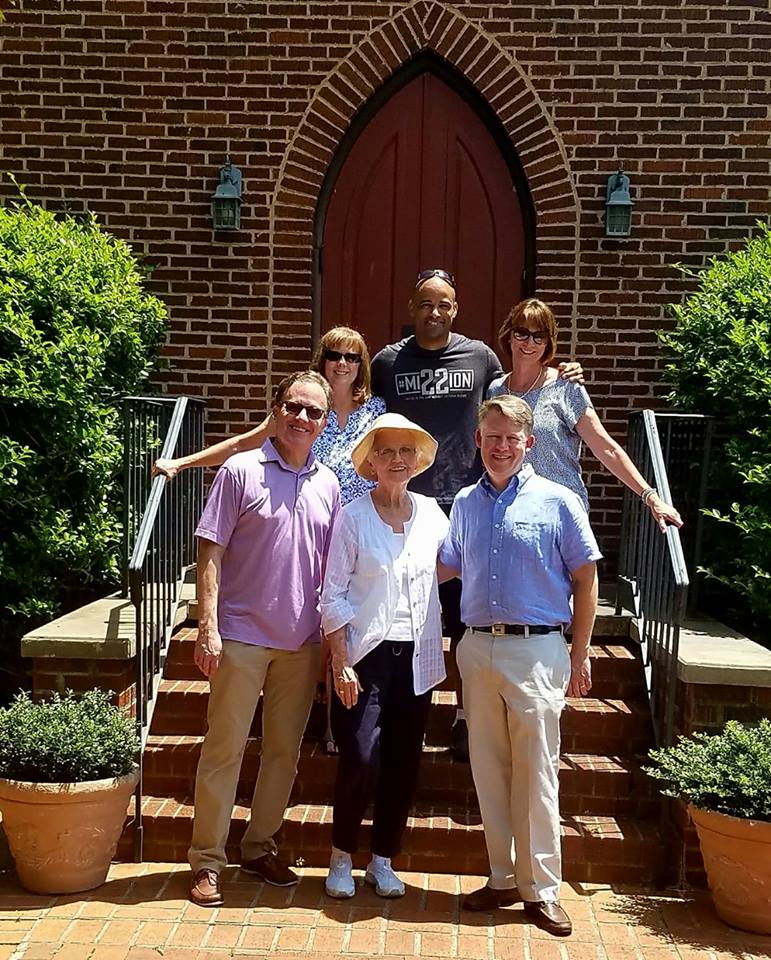
Rosborough cousins on the steps of St. Stephen’s, May, 2017. Front, L to R: James Wilson, Manny Edmunds Salters, Hamlin O’Kelley; Rear, L to R: Karen Copeland Vasquez, Jerome Roseborough, Jenni Rosborough
[1] The Century House was built in 1853 by Dr. James Buchanan Coleman from the land purchased from the family of Dr. James Thomas Rosborough some time before 1824 upon Dr. Rosborough’s widow’s move to Texas. “Uncle” Charles Thomas visited the “Texas cousins” some time in the 1930’s. [James Thomas Rosborough was one of John Cubit Rosborough and Robert Reed Rosborough’s brothers.] Coleman family records indicated that Dr. Coleman built on the property where John Rosborough’s home was located. John Rosborough’s home was a “two-story…wooden house…with beautiful pink climbing roses on the piazza…large rooms on both floors and silver door knobs and walnut stair rails….built before 1800….” Dr. Coleman’s older children were born in the Rosborough home. There is no indication of what happened to the Rosborough home to require the construction of the Century House. This was the site of General Pierre Gustave Toutant Beauregard’s temporary headquarters after the evacuation of Columbia, South Carolina, in the last days of the War Between the States. Just prior to Sherman’s advance, Beauregard and General Wade Hampton evacuated Ridgeway. See “The Century House” in Bolick, Julian Stevenson, A Fairfield Sketchbook pp. 26-28 (Columbia, 1963).
[The Century House still stands on the site of John Rosborough’s former home. We showed Jerome Roseborough his ancestral home site. Too bad the original house with pink climbing roses on the piazza and silver door knobs and walnut stair rails is no longer extant.]
Years ago, I went to LA with my family and some friends for Spring Break.
One of the days we were in LA, we went full on tourist. Mega-tourist. Tourist to the nth power times one hundred.
We went on the tour of the Warner Brothers studios and lots.
We bought swag in the gift store.
We then had the Uber driver take us to the Beverly Hills Hotel where there were some celebrities spotted.
Rob Long, one of my favorite high school teachers who is now in the Bidness, lives in Venice, CA. He also knows the our pals, because of course……..
Unfortunately, Rob was in New York at the time. I texted him about some of the spottings. His reply, “It’s what everyone imagines L.A. to be: a series of casual encounters with celebrities punctuated by juice drinks.” He makes a good point.
Anyway, after the sightings in said hotel and pictures of fronded wallpaper, we asked the amazingly helpful concierge for a map and a restaurant recommendation within walking distance. Said concierge showed us the way via the map through The Flats over towards Rodeo Drive. We walked to The Farm on North Beverly Drive and had a delightful lunch. Some of us were convinced someone at the next table was someone we all should have known. I had never seen the man.
Postprandial promenade: south on North Beverly; west on Brighton Way; and north on Rodeo. We had made it. The shopping mecca nestled between Santa Monica and Wilshire. Wait? This is it? Really? Seriously? Ok den.
I turned north on Rodeo. The rest of our crew turned South.
I walked by Bijan, Vera Wang, Tumi, Hermes, Gorgio Armani, and Ralph Lauren, and then walked back south the same way.
I remembered reading some years back in some architecture magazine that the Hermes on Rodeo had a cool space.
I like their ties.
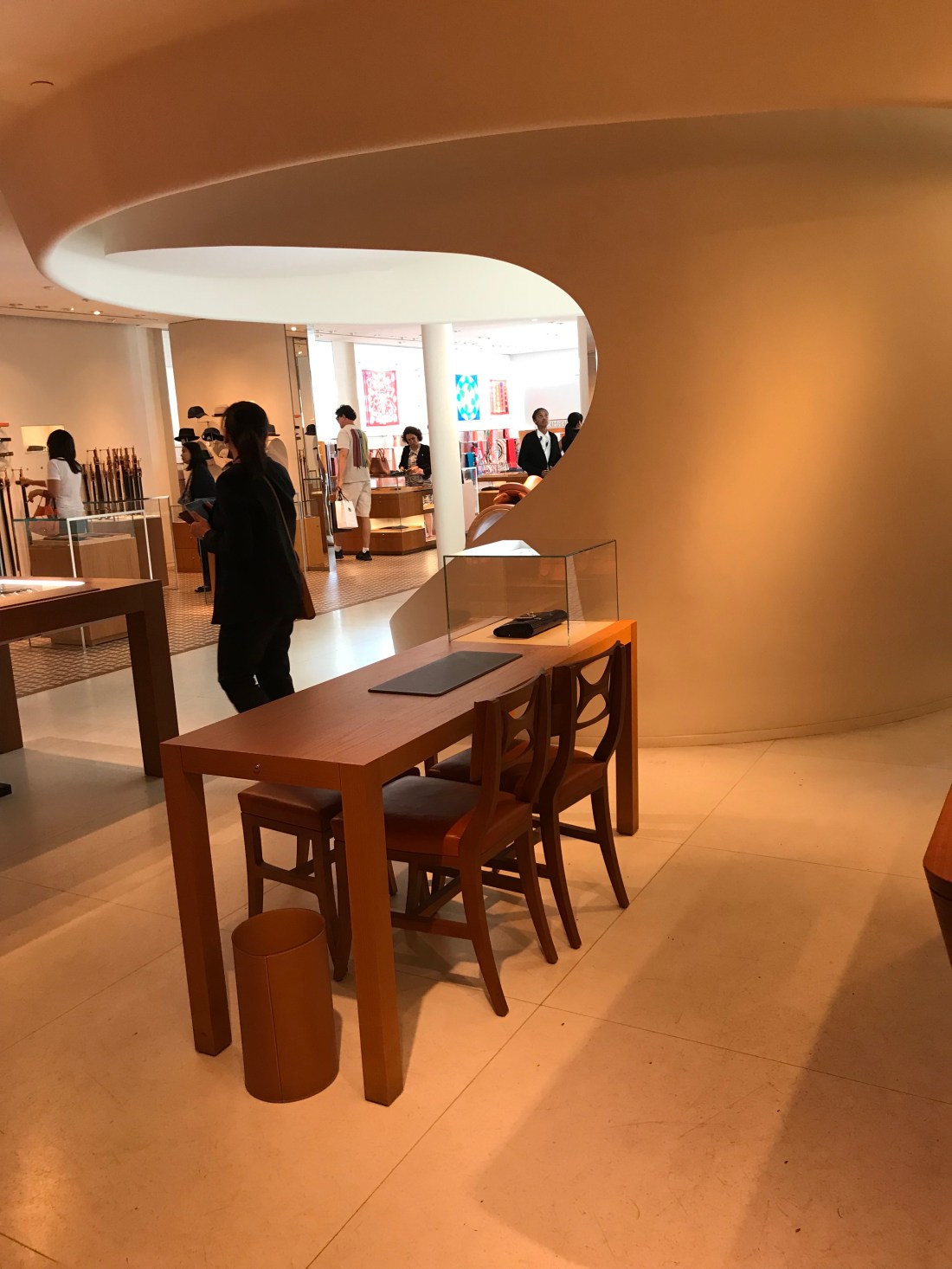
I went in to the emporium to give it a gander. The space designed by Rena Dumas, Architecture Interieure (RDAI) didn’t disappoint. She is an Hermes family member
Radically cool.
Here’s a glimpse
Of course I took a picture on the sly….such a tourist
Tons of light floods in from a roofless roof and down and around the store. Three floors of well lit lux. (See what I did there Latin scholars?)
As with most super high end stores, I was immediately asked if I needed any help. I asked where the ties where. Clerk showed me. I browsed. I chose.
As I was browsing, I noticed a flurry of activity out of one eye involving a man in full Sheik of Araby dress along with a retinue of handlers and three salespeople approaching the discreetly positioned registers. I was making my way to the same register, but I had to let the Sheik and his crew go before me.
I knew this was going to be good, perhaps great.
His Serene Sheikiness and crew did not disappoint.
I stood and waited and listened while the heavily French accented store manager personally tallied and typed into the store’s computer and made zee small talk.
“I ‘ope you found everyzing you needed, Sir”
“I did,” came his reply drier than the Sahara.
“Zee sadles we will ‘ave sent to you, no? Please, write zee address here, Sir.”
“Yes, please have them sent. They will be perfect for our use.”
“Do you ‘unt or just ride? ”
“Neither. I am a falconer for sport. Others hunt. My daughters, they ride.”
“Are you sure ziz bag is the right colour for your wife?”
“Yes”
“Parfait”
Saddles?
Falconry?
Fancy pocketbooks?
Wouldn’t it have been easier to get the saddles from Hermes, Paris?
Between the saddles, the ties, the scarves, and one small handbag, the grand total came to be around $34,000.
“Of course, zee shipping is complimentary.”
Now I get why it didn’t matter if the saddles came from Hermes Paris, Hermes Beverly Hills, or Hermes Timbuktu.
Parfait indeed.
“And, ‘ere is zee invitashion to zee private event in Paris in a few weeks. We ‘ope you can attend.”
“I won’t be coming,” replied the Sheik in full deadpan as he handed his black Amex to the manager.
“Well, we would love to ‘ave you zere”
I bet they would have. He seemed so fun. He would have added so much.
“I won’t be coming,” replied the Sheik for a second time.
“Well, if you change your mind, the invitatshion will be in zee bag.”
“I won’t be coming.”
With a few iconic orange boxes in a few orange bags, the Sheik and his crew departed to the cars idling out front.
Store manager beckoned me to approach with tie.
“I bet this doesn’t get me invited to Paris, does it?” I asked
“Well, would you like to come? I can include you. Truly. I can ‘ave zem pu you on zee list.”
“I won’t be coming,” I replied trying to imitate the Sheik’s deadpan.
In March, my family went to Los Angeles for Spring Break.
Our first stop was an old, old friend’s house. Forty years in at this point. She and her Mama were both there. Such a treat to see old friends. These folks had spent some time in Beaufort and still adore my hometown.
We were talking about people we all knew way back when, Lowcountry cooking, and things we all remembered.
My friend asked me, “Hamlin, is Netha Polite still alive?” Sadly, Netha Polite is no longer with us.
This friend is an accomplished cook, and she exclaimed with authority, “Well, she made the absolute BEST!”
The best what?
Biscuits
Netha Polite made biscuits Amazing biscuit.
(Sometimes the plural of biscuit is biscuit, BTDubs. At least it is in my family.)
Netha Polite would come to your house with her own mixing bowls, rolling-pin, and ingredients.
Hours later, your kitchen would be covered in a dusting of flour but your freezer would be full of the most perfect biscuits ever made. Ever.
Netha Polite brought her own utensils and bowls because, as she said in her Gullah accent, “You ain’t never know what walks in the night.”
She was serious.
She did not trust your kitchen to be up to her level of cleanliness.
Netha Polite came to my parents’ kitchen in downtown Beaufort. She sifted, mixed, rolled, cut, and stacked biscuit after biscuit. I remember walking through the kitchen and speaking. That’s about all I remember.
How I wish I had stayed right there and watched her. She did use sweetened condensed milk and lard (or was it evaporated milk and Crisco?) I should’ve paid attention
Her perfect biscuits were small. She never cut them more than two inches in diameter. They were not super tall, almost thin, but tall enough to put a slice of ham in between the layers. They were flaky. They were magic. They really didn’t need butter or honey or jam or jelly.
I have searched and searched for a receipt that mimics Netha Polite’s biscuit receipt. No luck. Any search reveals sweet cookies, the English style biscuit. I’m sure those type of biscuit have their place in the culinary world, but Netha Polite’s biscuit they are not.
So, I have resorted to culling biscuit receipts from others.
My mother-in-law, Becky Johnson, has a great biscuit receipt.
The late pioneering Chapel Hill, NC, chef Bill Neal has given me my favorite receipt.
I have a super easy biscuit receipt. It’s called “Easy Herb Biscuit”. It’s made with fresh herbs and heavy cream. These biscuit pair well with shrimp creole.
Still, none of these compare with Netha Polite’s. Nonewhatsoever.
Anyone in Beaufort have her receipt? Anyone? Anyone? Bueller? Bueller?
If you do, please let me know. I might be willing to pay for it. I’m serious. Let me know. Really.
Anyway, these versions hold up on their own, but they aren’t as good as Netha Polite’s.
But, as Netha Polite herself would have said, you ain’t never know.
Here go:
Bill Neal’s Biscuit
2 C. White Lily flour (so much has been said about Southern winter wheat flour that I need not say it again)
3 1/3 tsp. baking powder
1/2 tsp. baking soda
1/2 tsp. salt
5 tablespoons cold fat – lard, butter, Crisco or combination
7/8 c. butter milk
Sift the dry ingredients together in a bowl. Cut in the fat until it resembles crumbs. Add the buttermilk. The dough will be wet and sticky. Turn out onto a lightly floured surface and knead ten (10) times folding the dough over itself. Don’t over work. A light touch is bad in life but good in biscuit. Roll out until about 3/4 of an inch thick. Cut with small (2″) biscuit cutter. Don’t twist. Cut. Straight down and up. Bake on parchment lined baking sheet at 450 for 8-10 mins or until golden.
Don’t make big fat biscuit. They aren’t Nethaesque. Catheads belong on cats. Netha Polite would not have wanted a cat in the kitchen, especially if it walked in the night.
The late Mr. Neal’s receipt is my favorite and my go-to. I love them. They are indeed Southern AF. They are wonderful. But, they ain’t Netha Polite’s biscuit.
Here’s my mother-in-law’s recipe
Becky Johnson’s Biscuit
2 c. flour
4 tsp baking powder
1/2 tsp salt
1/2 c. shortening
1 egg
2/3 c. milk
Sift the dry ingredients in a bowl. Add the shortening and cut with a folk. Combine egg and milk and add to dry. Knead a few times and cut and bake at 450 for 10-14 minutes
The milk and egg work together to create magic with these, too. But, again, they ain’t Netha Polite’s.
Here’s my super easy herb cream biscuit. Quick, too.
Easy Herb Biscuit
2 c. flour
1/2 tsp salt
2 tbsps. fresh herbs chopped super fine: rosemary, thyme, parsley, dill – any combination
1 – 1 1/2 c. heavy cream
Sift dry ingredients. Add the herbs. Dump in 1 cup of cream. Might need more than 1 cup for the dough to come together fully. Knead a few times and cut. Bake 425 until golden. About 15 minutes. Beyond easy.
But, again, not Netha Polite’s.
I do love me a biscuit, though. Any time. Any place. Any where. From Bojangles to our friend’s Callie’s Hot Little Biscuit to Hardee’s to myriad Charleston restaurants, I will eat me a biscuit.
As my bride says, “You should be fat.”
None of us thought to go to Netha Polite and note her technique, her ingredients, her stories. Shame on us. A car struck Netha Polite one day when she was getting her mail. Died right there. And, I think her receipt died with her. Damn it.


 Dad, what's for supper?